What Gaelic Football Betting Actually Costs a UK Punter
 Available in US
Gaelic football crosses onto the British betting slip behind a sport most High Street bookmakers built their menus around, with prices built on margins that nobody prints on the coupon and bonus terms that look free until the small type is read. This page is about that cost — what a price keeps, what a free bet takes back, what an “odds boost” leaves out, and which licensed bookmaker offers the lightest load for the kind of bet the reader wants to place. Every brand named below holds a Gambling Commission remote licence for Great Britain.

As of 16 October 2026, offers and licence details have been checked against the Gambling Commission’s public register and each operator’s own published terms.
Data current as of October 30, 2026, based on checks of the Gambling Commission’s public register and each operator’s own published terms.
Gaelic Football: Shape of the Game
Senior inter-county Gaelic football is played on a grass pitch that runs 130–145 metres long and 80–90 metres wide. A match lasts 70 minutes — two 35-minute halves — and each team names 15 players on the field, with up to 15 substitutes of whom six may be used. The scoring system is what makes the betting maths different: a goal, the ball driven under the crossbar into the net, is worth three points, and a point, the ball sent over the crossbar, is worth one. Since the 2025 rule changes, a shot from outside the new 40-metre arc counts two points.
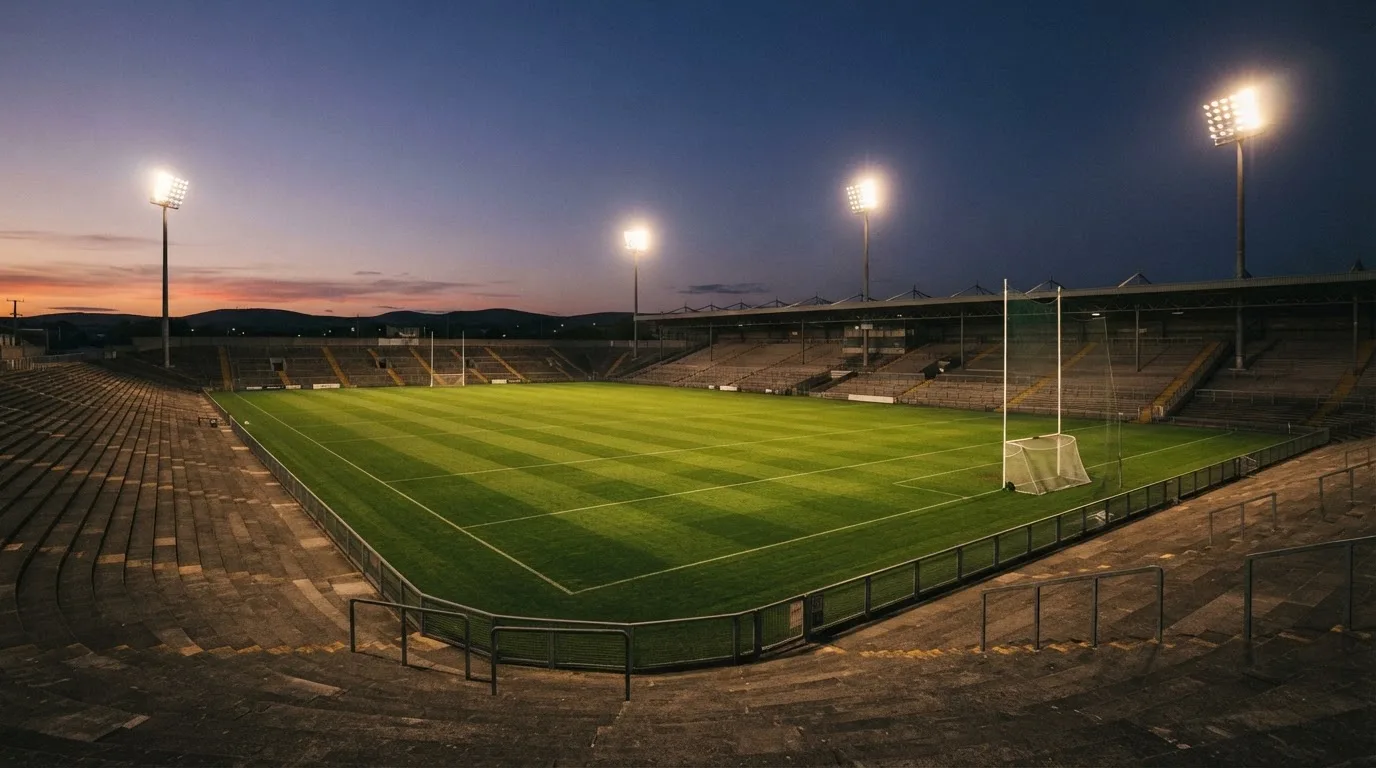
The sport is governed by the Gaelic Athletic Association (GAA), and the All-Ireland Senior Football Championship final is held each year at Croke Park, Dublin. Kerry hold the record for titles in that competition, with 39. The 2026 All-Ireland Senior Football Championship final was played on 26 July 2026 at Croke Park, with Mayo beating Kerry 1–20 to 1–17 for their fourth title. For the punter, the shape of the sport sits underneath every market: 70 minutes of play, a scoring system in which both teams can run up a tall total, and a 15-player roster that makes the live picture busy from the throw-in.
The Markets on a Gaelic Football Slip
Gaelic games betting at UK-licensed bookmakers tends to follow the football and rugby pattern — full-time result, the handicap line, total points, and a handful of in-play markets on the next score. The fraction of the match covered by live prices has grown: most licensed brands now open an in-play book on big GAA fixtures, with markets suspended and re-priced after each significant score. A GAA pitch is wider than a football one and the scoring happens more often, which is one reason why live betting on Gaelic football requires more arithmetic than its football cousin.

Reading the Bookmaker’s Margin
The bookmaker’s margin is the share of every unit staked on a market that the firm keeps, on average. It is hidden in the prices: the smaller the margin, the more a winning bettor keeps, and the slimmer the bookmaker’s cut. The way to see it is to take a market with two or three possible outcomes and convert each price to its implied probability (1 ÷ decimal odds), then add those probabilities together. The sum comes to more than 100 per cent; the amount over 100 per cent is the margin, and the share below 100 per cent is the payout share.
Take an illustrative two-way market priced at 1.90 against 1.90 (9/10 in fractional form). The implied probability on each side is 1 ÷ 1.90 = 0.5263, and 0.5263 + 0.5263 = 1.0526. The margin on the market is roughly 1 − (1 ÷ 1.0526) = about 5.0 per cent, and the payout share is about 95.0 per cent. Across many bets at that price the bookmaker keeps around 5p in every £1 staked between the two outcomes; the rest is paid back in winnings. For a tighter market — say 1.85 against 1.85 — the margin rises towards 7.5 per cent, and a 1.95 against 1.95 market drops it close to 2.5 per cent. The band a reader should expect on a typical GAA two-way line sits between roughly 2.5 and 7.5 per cent of stake, depending on the bookmaker and how soon before throw-in the price is taken.
Margin is statistical, not a fee: it is the average the bookmaker keeps over the long run, not what any single bet costs. A reader who bets ten times at 1.90 against 1.90 will not lose exactly 5 per cent of stake; they will win some, lose some, and on average across many bets the bookmaker’s edge will pull that close to 5 per cent of turnover.
The Ten Licensed Operators Reviewed
Each brand below is listed on the Gambling Commission’s public register against a remote general betting licence for real events. A place on this list is not an endorsement; it is a starting position for a comparison of how each operator prices and packages Gaelic football betting.
| Brand | Licence holder (GC account) | GC remote licence | What the operator’s own terms state on the subject |
|---|---|---|---|
| Ladbrokes | LC International Limited (54743) | 054743-R-330863-014 | Sports betting app published by Entain Operations Limited; app rated 4.66 from 101,255 GB App Store ratings |
| Paddy Power | PPB Counterparty Services Limited (39439) | 039439-R-319330-013 | Sports betting app covers football, horse racing, boxing, rugby, tennis, golf, darts, snooker and F1 |
| DAZN Bet | DZBT Limited (48756) | 048756-R-327274-019 | Deposits from £5 via debit card, Apple Pay, Paysafecard, Trustly and Skrill; from £20 via PayPal; no processing fees |
| BetUK | LeoVegas Gaming PLC (39198) | 039198-R-319450-029 | Welcome offer: four £10 free bets (two football accas of 4+ selections, two multiples of 2+) on a £10+ deposit and bet within 7 days of registering; 7-day free-bet validity; opt-in required |
| Sporting Index | Sporting Index Limited (27343) | 027343-R-308898-011 | Lets customers switch between fixed odds and spread betting; in-play betting, Bet Builder for football, auto cash-out and Multi-Markets |
| BoyleSports | Boylesports Enterprise (39469) | 039469-R-319383-025 | UK welcome offer: £20 in free bets on a qualifying £10 bet (Irish customers: €30 free bets on a €10 bet) |
| Lottoland | EU Lotto Limited (38991) | 038991-R-319408-020 | App combines casino, lottery betting, sports betting and scratchcards; licensed by the Commission for customers in Great Britain |
| Octobet | Octopus Game Limited (62545) | 062545-R-337248-006 | Sportsbook welcome offer: 50% back as a free bet up to £50, plus a £10 casino bonus |
| Kwiff | Eaton Gate Gaming Limited (44448) | 044448-R-323408-017 | Licensed by the UK Gambling Commission; described as a trademark operated by Spryme Ltd; 17+ App Store age rating |
| Betboro | Webmedia Development N.V. (44181) | 044181-R-324363-007 | Welcome offer: 100% matched free bet up to £25 on first qualifying wager; debit-card deposit of at least £10; first bet £5 to £25 with three or more selections, each at 3/5 (1.60) or higher |
The licence numbers in the table are quoted from the Commission’s public register; the licence-holder column names the company on the register, not the trading name a customer sees on the site. Where several trading brands sit under one licensee — as Ladbrokes and Coral do, or Paddy Power and Betfair — they are not separate operators for the purpose of regulation. Every brand above takes part in GAMSTOP, the national online self-exclusion scheme that has been a licence condition since 31 March 2020.
Ladbrokes
Ladbrokes runs its GB site through LC International Limited under remote licence 054743-R-330863-014 and ships a sports betting app rated 4.66 across 101,255 GB App Store ratings. The Ladbrokes brand sits inside a wider Entain group, which means its sportsbook shares pricing infrastructure with Coral, and customer wallets can move between the two without a fresh sign-up. For Gaelic football the practical question is whether the sportsbook puts GAA lines on the main coupon and how aggressively it prices the All-Ireland rounds: Entain-run books tend to add GAA inside the larger “Other Sports” or “International” tab rather than promote it, which keeps the menu from getting bloated during the off-season but also means a casual user may need to search for the fixture. The verdict: a broadly priced book with a serious welcome structure and a deep in-play layer; the reader who places one big accumulator a month gets a familiar envelope, the reader who wants GAA-framed content has to dig for it.
Paddy Power
Paddy Power trades under PPB Counterparty Services Limited on remote licence 039439-R-319330-013, and its sports betting app covers football, horse racing, boxing, rugby, tennis, golf, darts, snooker and F1 — a long menu that traditionally puts GAA alongside an “Irish Sports” or novelty tab. The same Flutter group runs Betfair, and the price engine is shared with that exchange, which means in-play liquidity on GAA fixtures at Paddy Power tends to be strong when the All-Ireland rounds draw real money. The verdict: a brand priced for action and built for an Irish-lean punter; pricing on GAA outrights is among the keenest on the panel, though the menu discovery mirrors Ladbrokes in keeping Gaelic football off the front page.
DAZN Bet
DAZN Bet operates through DZBT Limited on remote licence 048756-R-327274-019. Its deposit terms are unusually specific: from £5 by debit card, Apple Pay, Paysafecard, Trustly or Skrill; from £20 by PayPal; with no processing fees charged by the operator. For a small-stake punter who wants to keep the deposit cost out of the betting cost, the lower entry point is the load-bearing detail — the £5 floor keeps the postage-stake bet from being uneconomic. DAZN Bet is also a streaming-facing product rather than a coupon-facing one; the menu is built around what the broadcast shows, and GAA on British screens means the sport appears when the rights do. The verdict: a brand that suits the smaller-budget bettor who wants to stake in pennies while watching, at the cost of a less exhaustive pre-match menu on GAA.
BetUK
BetUK’s licence sits with LeoVegas Gaming PLC under remote licence 039198-R-319450-029. Its UK welcome structure addresses a common British punter case — the £10 first bet that asks for four things in return: two football accumulators of four or more selections, and two multiples of two or more, each £10, all valid for seven days, with opt-in required and a single qualifying bet placed within seven days of registering. The package is generous by headline, but the cost is in the conditions: the four free bets are not interchangeable across sports (a GAA accumulator of four selections is on the menu, but a single GAA free bet is not), and each free bet expires seven days after issue. The verdict: a strong choice for the punter who places football accumulators anyway, and a less obvious one for the GAA-only customer who will be forced to settle for free bets on a sport they were not planning to back.
Sporting Index
Sporting Index runs under remote licence 027343-R-308898-011 and lets customers switch between fixed odds and spread betting on the same account; in-play betting, a Bet Builder for football, auto cash-out and Multi-Markets round out the feature set. The spread-betting arm sits under a different regulator: Spreadex-style spread products on financial indices are FCA-regulated, while sporting spread bets at Sporting Index go through the Commission’s general betting regime, and losses on spread bets can exceed the deposit. The cost picture is double-edged — spread bets on a high-scoring GAA match can settle for far more than the stake, and the bookmaker’s “margin” comes in the spread rather than the overround. The verdict: a genuine alternative for the reader who likes both forms of betting and reads the size of the spread before staking, not the punter who wants a single clean price on the All-Ireland.
BoyleSports
BoyleSports is licensed under 039469-R-319383-025 and its UK welcome offer is £20 in free bets when a qualifying £10 bet is placed — a £30 free-bet package for Irish customers placing a €10 qualifying bet. The firm’s Irish heritage, like Paddy Power’s, shows in the GAA menu: BoyleSports tends to list GAA alongside horse racing and football on its coupon, with outrights on the All-Ireland open far enough ahead of the championship for ante-post value to build. The verdict: an Irish-rooted book with the pricing that heritage implies; a strong match for a GAA-focused punter who also bets on Irish horse racing, less obvious for a reader whose interest in Irish sports does not extend beyond football.
Lottoland
Lottoland’s remote licence is 038991-R-319408-020, held by EU Lotto Limited, and its app combines casino, lottery betting, sports betting and scratchcards. The product is best understood as a lottery-led bookmaker with a sportsbook in tow — sports betting exists as a complement to the lottery core, which means the GAA menu is competent rather than deep, and pricing is set to compete with the bigger sports-only brands without outspending them. The verdict: a brand that suits a reader who keeps one foot in lottery and the other in sports, not the punter who wants a specialist GAA book.
Octobet
Octobet’s licence is 062545-R-337248-006, held by Octopus Game Limited, and the welcome package is half-back-as-a-free-bet up to £50 plus a £10 casino bonus — a “loss-back” shape, which means the reader stakes, and if the first bet loses the operator returns up to £50 as a free bet (the stake itself is gone). On the cost side, half-back is leaner than a matched free bet because the qualifying stake is at risk; a punt on a GAA outright at 5/1 loses outright if the team comes up short, and only half of any loss comes back as a free bet. The verdict: a heavy first-timer bonus for the punter who is going to bet anyway and treats the free-bet return as a consolation, not a substitute for a careful price.
Kwiff
Kwiff operates under remote licence 044448-R-323408-017 and describes itself as a trademark run by Spryme Ltd. The brand is known for “surprise” odds boosts — randomly enhanced prices on selected selections, with a maximum-stake cap attached — and that feature carries a specific cost: the cap means the boost cannot be exploited at high stakes, and the randomisation means the bookmaker, not the punter, picks which lines get the lift. The verdict: a brand worth a second look for the casual bettor who likes the thrill of an unexpected price, and a less obvious fit for the strategic punter who wants control over which bets receive an edge.
Betboro
Betboro is licensed under 044181-R-324363-007 and its UK welcome offer is a 100% matched free bet up to £25 on the first qualifying wager, requiring a debit card deposit of at least £10 and a first bet of £5 to £25 with at least three selections at 3/5 (1.60) or higher. The minimum-price rule at 3/5 (1.60) is the load-bearing condition: an acca of three GAA favourites at 1.60 will qualify, but a single GAA bet at 2.50 (6/4) does not, and a GAA outright at 5/1 does not either. The verdict: a fair welcome package whose conditions lean towards accumulators rather than singles or outrights, suited to the bettor who already bets in multiples and indifferent to the reader whose GAA betting is single-bet.
What a Free Bet Really Costs
The packaging of a free bet conceals two costs the headline does not print. The first is that the stake is usually not returned with a winning free bet — a £10 free bet at 4/1 returns £40 in profit, not £50, because the original £10 was the bookmaker’s money and is not paid back. The second is that free bets expire, often within seven days of issue, after which the unused credit is removed and the bookmaker keeps the stake without it having been staked.
The shape of value: a free bet worth £10 at decimal odds of 3.00 settles for £20 of profit if it wins. Its expected value depends on the market margin: at a margin of 5 per cent the free bet is worth roughly £10 × (3.00 − 1) ÷ 3.00 × 95 per cent = about £6.33 on average — a discount on the headline £10, paid in the small type rather than the marketing line. A “100% matched free bet” advertised at £25 is therefore worth about £15.83 to £18.97 against a market priced at 3.00, after the stake-not-returned rule and the margin are both paid for.
Bonus Caps and What They Mean
Promotion rules in force since 19 January 2026 cap wagering requirements on bonuses at 10x — a £10 bonus at 50x would, after the cap, need £100 of qualifying bets. Mixed-product promotions that ask a customer to bet on two or more product types (betting plus casino, for example) are banned. The 10x cap is a ceiling, not a starting point; a £10 bonus at 20x still requires £200 of bets before it can be withdrawn, and the § in the small type still matters. No cap on the money value of a bonus has been confirmed; only the rollover rule has a number.
Whether the cap applies to a free bet with no wagering condition was not confirmed; the Commission’s published rules speak to rollover on cash bonuses, and a free bet that turns into withdrawable cash without a multiplier is a different shape. A reader should read the bonus terms line by line rather than assume the headline number survives the qualifying conditions.
Spread Betting and the Cost Beyond the Stake
Spread betting is gambling of a different shape. On a GAA total-points spread, the punter does not pick an outcome — they pick a number (the “spread”) and stake a unit amount per point that the actual total differs from it. A £5-per-point stake on a total of, say, 38 to 42 points returns or loses £5 for every point the final total lands above or below the chosen line, with no ceiling. Sporting Index lets customers switch between fixed odds and spread betting on the same account, but the cost picture is not the overround: it is the spread itself, which is the bookmaker’s stake on where the total will land, and a wider spread means a larger margin in the bettor’s favour or against it.
Spreadex is regulated by the Financial Conduct Authority for spread betting on financial markets and by the Gambling Commission for fixed-odds betting on sports — and the firm’s own terms warn that spread betting losses can exceed deposits. A reader who treats a spread bet like a fixed-odds coupon is paying for that misreading in real money.
Where Gaelic Football Sits in the British Menu
Gaelic football is a niche line at most British-licensed bookmakers. The Championship and the main provincial championships (Leinster, Munster, Connacht, Ulster) reach the menu during the calendar the GAA runs — late spring through the All-Ireland final in July — and the All-Ireland club championships fill the late autumn. Outside those windows, GAA drops to outrights on the next championship or to nothing. A punter who wants to build a multi-event GAA accumulator needs to plan around the calendar; the menu is deepest in the four to six weeks before the All-Ireland final, then thins.
In-play betting on Gaelic football is offered by all the books in the comparison above to varying depths. The pattern is the same one football and rugby follow: matched outrights, next-score markets, and the totals line once the match is in flow. The in-play margin is usually wider than the pre-match margin because the book carries more uncertainty; a price that opens at 1.90 against 1.90 pre-match can move to 1.85/1.85 within minutes of the throw-in.
Cash Out and Book-Management Features
Cash out, bet builder, accumulator insurance and acca boosts are the four features that change the cost of an unsettled bet most directly. Cash out lets a punter lock in a position before the match ends — at a price the book sets, with a margin that is wider than the pre-match or in-play margin because the bookmaker is taking on a fresh liability. Bet builder combines markets from one event into a single bet; the margin inside a bet builder is the sum of the per-selection margins multiplied together, which is why a bet builder’s combined price is worse than the same markets priced separately when they are available separately. Acca insurance returns a stake as a free bet if one leg lets the accumulator down; the cost is the higher margin inside the multi that funds the insurance pool. Acca boost increases the price of a winning accumulator by a percentage; the cost is usually funded through a tighter price on each leg.
Of the panel above, Ladbrokes, Paddy Power, BetUK and BoyleSports all carry cash out as standard. Sporting Index supports auto cash-out. Kwiff’s signature is its randomised odds boost. Each feature shifts cost from one part of the bet to another — almost always by widening a margin somewhere — and a punter who reads the feature as a saving rather than a re-pricing is paying for the gap.
Live Streaming and Watching While Betting
A separate licensed bookmaker — bet365 — is the official global betting partner of the UEFA Champions League and runs the most-downloaded sports betting app in the UK, with a Bet Builder that combines markets from one event into a single bet, available pre-match and in-play. The bet365 streaming and pricing infrastructure is the closest comparison point in the British market for a bookmaker whose sports list runs to small fixtures. bet365 is not part of the comparison panel above; it is included only as a benchmark for the live-experience end of the menu.
For Gaelic football specifically, the licensing rights to GAA broadcasts are not sold to a single UK bookmaker, and in-play video for a GAA match is rarer at a licensed bookmaker than in-play video for Premier League football. A reader who wants to watch and bet on a GAA match in the same window should check whether the operator’s streaming list carries the fixture on the day.
Verifying a Gambling Commission Licence
A bookmaker’s claim to be “fully licensed” is checked in two minutes through the Gambling Commission’s public register, which can be searched by business name, trading name, domain or account number. The register lists the operator’s licence number, the licence categories held (remote general betting standard (real events), remote general betting standard (virtual events), remote general betting limited, remote pool betting, remote betting intermediary for exchanges), and the company named as the licence holder. The trading name on the website and the licence holder on the register are not always the same string — Ladbrokes is a trading name of LC International Limited, Paddy Power of PPB Counterparty Services Limited — and a reader who sees only the trading name on the page is being shown the brand, not the regulated entity.
The register also names the operator’s licence type. A remote general betting standard (real events) licence covers fixed-odds betting on real events such as a Gaelic football match; a remote betting intermediary licence covers an exchange. An operator whose site claims to offer a category of betting should have a corresponding line on the register, and the categories named on the licence are what the operator may legally offer. Anyone offering bets to a customer in Great Britain needs a Commission licence; a Curaçao, Maltese or Gibraltar licence alone is not sufficient for British customers.
Payment Methods and What They Cost the Bettor
Credit cards have been banned for gambling in Great Britain since 14 April 2020, including payments through an e-wallet that are ultimately funded by a credit card. Debit cards and bank-based payments are not covered by that ban. Beyond that rule there is no state list of permitted payment methods: each licensed bookmaker draws its own list, with e-wallets, prepaid cards and bank transfers sitting alongside debit cards.
Identity verification before the first deposit — in force since 7 May 2019 — means no anonymous play at a licensed site. A punter who values anonymity over the protections a GB licence offers will find that the licensed market is closed to them; the alternative is an offshore bookmaker, and the cost of that path is described below.
A British rule that names a specific payment method as state-permitted or state-prohibited at a licensed operator was not established. Cryptocurrency payments at licensed operators are not confirmed, and no clear rule governs cryptocurrency deposits in Great Britain. A reader who wants to deposit in crypto should check the operator’s banking page directly.
Responsible Gambling at Licensed Operators
Every licensed operator in the comparison above takes part in GAMSTOP, the national multi-operator online self-exclusion scheme that has been mandatory for online licence-holders since 31 March 2020. GAMSTOP periods run for six months, one year, five years, or five years with auto-renewal; once the minimum period ends, the exclusion stays in place for a further seven years unless the customer asks GAMSTOP to remove it. The service covers online sites and apps, while betting shops use a separate service for self-exclusion.
A financial vulnerability check, in force since 30 August 2024, applies to licensed remote betting when a customer’s deposits minus withdrawals exceed £150 in a rolling 30 days (since 28 February 2025). The check is a public-record check (bankruptcy or county court judgments), not an income check and not a credit reference check. Financial risk assessments, sometimes called “affordability checks” in the press, were announced in a staged plan in July 2026 with no confirmed start date — write them down as “announced, staged, no start date”, not as a rule in force.
Deposit limits are required under RTS 12, with the first changes applicable since 31 October 2025 and a second phase postponed to 30 September 2026. The limits are the customer’s choice — there is no state-set deposit or loss ceiling for betting — and the operator’s terms describe the form of the limit. Help services are linked from every licensed operator’s responsible-gambling page: GamCare (the National Gambling Helpline), GambleAware, NHS gambling clinics and Gamblers Anonymous are the four recommended routes.
Bonuses and Free Bets at the Compared Brands
Each brand in the table above carries its own welcome package, and the packages differ in shape as well as in headline number. BetUK’s £40 free-bet package is split across four bets (two football accumulators of 4+ selections, two multiples of 2+), with a seven-day expiry that consumes all four at once if a single bet is left until the last day. BoyleSports’ £20 on a £10 qualifying bet is one of the lighter welcome packages, with the trade-off that the qualifying bet needs no minimum number of selections. Octobet’s half-back up to £50 trades a cash-back safety net for the headline match; Betboro’s 100% matched free bet up to £25 has the tightest minimum-price rule of the panel.
None of these packages is a credit-card-funded free bet, because credit cards are not permitted for gambling in Great Britain. The qualifying deposit at every licensed bookmaker has to come from a permitted method — a debit card, a bank transfer, an e-wallet, a prepaid card — and the bonus terms specify which methods qualify. A deposit from Skrill, for example, is sometimes excluded from bonus offers at licensed operators; a reader who plans to claim a welcome bonus should check the qualifying-method line before they deposit.
In-Play Margin and the Cost of Live Prices
The in-play margin on a Gaelic football match is wider than the pre-match margin, with the gap depending on the operator and the number of selection points a bookmaker is offering at any given moment. The reason is mechanical: at the throw-in the bookmaker has less information than the punter watching the screen, and the wider margin compensates for the uncertainty. After each score the market is suspended, re-priced, and re-opened, and the margin on each re-pricing reflects the bookmaker’s read of the new state of play.
A punter who plans to bet in-play on GAA should treat the first five minutes of trading as a price discovery phase, with the margin inside it closer to a football in-play margin than to a baseball one. After a settled score line the bookmaker re-prices with a tighter margin, particularly on the totals line where the score effect is small relative to the remaining minutes.
Verification, Money-Laundering and Customer Checks
Name, address and date of birth are verified before a customer can deposit or gamble at a licensed operator — in force since 7 May 2019, with the rule applying equally to a real-money bet and to a free bet or bonus. Source-of-funds questions at higher spend are normal under the money-laundering rules and not a sign that an operator has flagged a customer for wrongdoing; the questions are part of the licence conditions of every operator in the comparison.
A punter who fails a verification step is restricted from withdrawing, regardless of whether they have won or lost. The check is a recurring line item in the help pages of operators in the comparison, and a reader who values fast withdrawals should keep their documents up to date before the first bet, not after a winning week.
Offshore Operators and What the Loss of Licence Costs
Providing gambling facilities in Great Britain without the licence the Gambling Act 2005 requires is an offence aimed at the operator, with a maximum sentence of 51 weeks’ imprisonment or a fine up to level 5, or both (six months in Scotland). No offence aimed at a customer who places a bet on an unlicensed site exists; the law targets the supplier, not the buyer.
The cost of betting on an unlicensed site falls on the customer in other ways: no GAMSTOP coverage, no Commission complaints route, no approved dispute-resolution body, no British consumer redress if funds are withheld, and no protection from the bonus cap, the financial vulnerability check or the LCCP marketing rules. Enforcement is disruption of the unlicensed operator — cease-and-desist notices, search-engine referrals, work with registrars, hosts and payment providers — and the Commission has been given or is about to receive court-order DNS blocking powers; ISP blocking is not in operation, and customers of an unlicensed site remain reachable until the operator’s infrastructure is taken down.
In plain terms: a licensed site carries the checks, the limits and the GAMSTOP layer, with the trade-off that identity verification is non-negotiable; an unlicensed site removes that check, and removes the protections alongside it. Neither is “the safe choice” without further comment, and a reader who chooses an unlicensed site chooses that trade.
Tax and the Player’s Position
A punter in Great Britain pays no tax on betting winnings. General Betting Duty is the operator’s tax on gross profits, currently 15 per cent, with a new remote rate of 25 per cent applying from 1 April 2027 while remote bets on UK horse racing, self-service betting terminal bets, pool betting and in-person betting stay at 15 per cent. Spread betting has its own rates (3 per cent financial, 10 per cent other). Until 1 April 2027 the remote rate stays at 15 per cent; whether operators pass duty on through their prices is not established. The Commission’s statutory levy is a separate charge, not a tax on winnings.
A professional gambler — somebody whose betting is a trade rather than a hobby — should speak to HMRC or a tax adviser before treating winnings as untaxed income. The general position above is information, not advice.
Advertising Standards for Bonuses and Promotions
Marketing at a licensed operator runs under the CAP Code (non-broadcast) and the BCAP Code (broadcast), enforced by the ASA, with the LCCP marketing conditions adding gambling-specific requirements. CAP Code section 16 requires marketing to be socially responsible, of no strong appeal to under-18s, and with no one who is or seems to be under 25 featured gambling or playing a significant role in the advertisement (with an exception for marketing placed where a bet can be made directly). The “under-25” rule is about who may appear in the advertisement, not about who may bet.
Betting advertisements are not broadcast on TV from five minutes before a live sporting event to five minutes after it, before the 9pm watershed (a code known as “whistle-to-whistle”). Horse and greyhound racing are exempt. The Premier League clubs’ withdrawal of gambling sponsorship from the front of matchday shirts, from the 2026/27 season, is voluntary, not law; sleeves and hoardings remain.
Operators are responsible for the marketing their affiliates do. A reader who sees a casino-led bonus advertised by a sportsbook affiliate is seeing content covered by the same bonus cap as a casino-direct advertisement, and the same 10x multiplier ceiling applies.
Notes on Each Brand at a Glance
Ladbrokes: large sportsbook, established brand, GAA line buried in “Other Sports”.
Paddy Power: large sportsbook, Irish-rooted menu, shared price engine with Betfair.
DAZN Bet: deposit-friendly floors, broadcast-led product, narrower GAA menu.
BetUK: four free bets on a £10 qualifying bet, but acca-shaped.
Sporting Index: fixed-odds and spread on one account, FCA-style risk on the spread side.
BoyleSports: Irish heritage, generous welcome for UK customers.
Lottoland: lottery-led product with a sportsbook in tow.
Octobet: half-back free bet up to £50 plus a casino bonus.
Kwiff: randomised odds boosts, capped stakes.
Betboro: 100% matched free bet up to £25, acca-only on the qualifying bet.
The Cost Picture Across the Ten
Reading the ten as a cost picture rather than a ranking: the lightest load on a small-stake punter sits at DAZN Bet, with its £5 deposit floor and no processing fees. The richest welcome package in cash terms sits at BetUK’s four-bet welcome, but the four-bet shape loads the cost onto the punter who already bets in multiples. The most product-flexible brand sits at Sporting Index, with the load-bearing risk that spread betting losses can exceed deposits. The risk-free-looking welcome at Octobet is half-back free bet, not matched free bet, and that word — “half-back” — is the one the page should read twice before the qualifying bet is placed.
The Margin Calculation in One Sentence
An illustrative two-way market priced at 1.90/1.90 implies a margin of about 5.0 per cent and a payout share of about 95.0 per cent, which is the size of the slice the bookmaker keeps on average across many bets; a tighter 1.95/1.95 market drops the margin to around 2.5 per cent, and a wider 1.85/1.85 market lifts it to about 7.5 per cent. The calculation is an estimate; no single bet will land exactly on the implied probability.
The Calendar of the GAA Betting Year
The Championship kicks off in late spring and runs to the All-Ireland final in July, with provincial championships (Leinster, Munster, Connacht, Ulster) feeding into the All-Ireland series from May onwards. The All-Ireland club championships fill the late autumn. Outside these windows the GAA menu at a licensed bookmaker shrinks to outrights on the next year’s All-Ireland or to nothing at all. A punter who wants accumulator insurance on GAA needs to plan the calendar first and the bet second; the matched-odds book is at its widest in the four to six weeks before the All-Ireland final.
Frequently Asked Questions
How does a punter bet on Gaelic football?
A punt is placed by selecting a market from a licensed bookmaker’s GAA menu — full-time result, handicap, total points, player markets where offered — and entering the stake on the bet slip. The book settles at the end of the match (or at the end of the live event, for an in-play bet). Stakes at a licensed bookmaker in Great Britain can be placed from age 18, with name, address and date of birth verified before the first deposit.
How can it be checked that a bookmaker holds a Gambling Commission licence?
The Commission’s public register lists every operator by business name, trading name, domain or account number, and shows the categories on the licence (remote general betting standard (real events), remote betting intermediary, and so on). The licence holder is the regulated company; the trading name on the site is the brand. A GB bookmaker without a line on the register is unlicensed for British customers and should not be used.
How is a return on a bet worked out from the stake and the odds?
The decimal odds multiply the stake to give the total returned if the bet wins: a £10 stake at 3.50 returns £35 in total, of which £25 is profit and £10 is the original stake. A combination bet combines several selections by multiplying the odds together, so a £10 stake on two selections at 3.50 and 2.00 returns £70 in total (3.50 × 2.00 × £10), of which £60 is profit.
What is the bookmaker’s margin and how is it seen in the odds?
The margin is the share of every unit staked on a market that the bookmaker keeps, on average. It is read by converting each price to its implied probability (1 ÷ decimal odds), adding those probabilities together, and subtracting from 100 per cent. A market priced at 1.90/1.90 has a margin of about 5.0 per cent; a market at 1.95/1.95 has a margin closer to 2.5 per cent.
How do fractional odds such as 5/1 convert to decimal odds such as 6.00?
The decimal odds are the fraction a/b plus 1, so 5/1 (5 ÷ 1 + 1) becomes 6.00, 11/4 (11 ÷ 4 + 1) becomes 3.75, and evens (1/1) becomes 2.00. The decimal price includes the original stake; the fraction shows only the profit. Decimal odds are easier to compare across markets and across operators, which is why a spreadsheet of GAA prices is usually built in decimal.
Rugby, cricket & Gaelic – Independentbookies.com
Content created by the «Independentbookies.com» team
